Rabu, 11 Juli 2012

The Missing Lessons From the Way - 8 - 26


(For Adam Ostrowski.)

Lessons from the Way of the Showman - 26

Creation will take whatever time is allotted.
and no matter how long you have, the final week it will seem like it'll never be ready. But opening night the show is born whatever shape, form or sex it is. And you'll have to love it.

Lessons from the Way of the Showman - 25

It is paramount that you actually want to be on stage and that the crowd feels it.

Once you can telegraph this you'll have a perfect foundation to build your act on.


Lessons from the way of the Showman - 24

Aim to discover one new moment each time you do your act.

One reaction from the crowd that's new, an extra groan, an unexpected laugh - remember it and recreate it.
After 12 shows you'll need to lengthen your music or eliminate the weakest bits. You now have a natural selection happening. Your act is adapting and evolving.

Lessons from the Way of the Showman - 23

Turning seemingly facile novelties into unexpectedly moving spectacles, that is the power of the Way.


Lessons from the Way of the Showman - 22

The audience is the showman's director, watch them watching you.


Lessons from the Way of the Showman - 21

Failure is inevitable if you're doing something complicated.

If you try something and get it the first time - complicate it and do it whilst doing something else and you might have the beginning of an act.

Lessons from the Way of the Showman – 20

To create imagined worlds you must know reality.

As a Showman's craft is infused with with make-believe he should make an effort to also explore reality.

A healthy study of the world can only enhance the Showman's imagination.

Lessons from the Way of the Showman - 19

A show is artificial

to deny this is a lie
a rockstar being himself in casual clothing
is more phony than a clown
in make up and a red nose


Lessons from the Way of the Showman - 18

The premiere of an act is its birth.

The rehearsals is the pregnancy, where all is developed out of sight. At birth the act is full of life, its beautiful (in its own way,) but has yet to find its feet. In time it will grow strong and wise.

Lessons from the Way of the Showman – 17

Difference is the fuel of evolution.

Tiny individual differences drive life onward. This is what we celebrate in the Sideshow.
The Carnival is place where being different makes you stronger.

Lessons from the Way of the Showman - 16

In theater less is more, in sideshow less is not enough.


Lessons from the Way of the Showman - 15

Collective learning made us humans different.

We have learnt since we became human OR we became humans when we could communicate learning. One person telling others. This was the roots of the Show Man.


Lesson from the Way of the Showman – 14

By mastering the Craft the Showman creates Art.


Lessons from the Way of the Showman - 13

The Showman is an honest liar.

Real or not is the heart of the Carnival.
I am a Showman and EVERYTHING I say is a lie - Everything.

Lessons from the Way of the Showman – 12

The Showman is a dream weaver.

His Craft is his loom, the fabric his Art and the weaving happens in the Show.
The Showman uses his Craft to weave dreams into reality creating Art in the process.

Lessons from the Way of the Showman - 11

The showman’s art is not physical it is spiritual,

relating to the human soul.
When the show is done, the show is gone - from the physical world.
Remaining only in the Crowd's hearts.

Lessons from the Way of the Showman - 10

A sculptor's Art is shaping clay.

The Showman's Art is molding human minds.

Lessons from the Way of the Showman - 9

a show is imagination made real


Lessons from the Way of the Showman - 8


            Craft

Showman            Crowd

There is a significant relationship between a Showman, his Craft, and the Crowd.

The link between the Crowd and the Showman is the Craft of Showmanship. From this link the Crowd gives the Showman's otherwise useless skills Meaning and simultaneously the Craft can be deeply Meaningful for the Crowd.

Rabu, 04 Juli 2012

Meaning In Entertainment

Rambling - under the influence

I struggle with the dichotomy of meaning and entertainment. Can I produce a show which at once is appealing to the mind and eternity as well as capturing the crowds imagination today?
The question is age old. Goethe writes about it in his Prologue In The Theatre from his Faust (1828) where three characters discusses the business of creating shows. The Manager character is interested in selling tickets and is trying to find the balance between the Jester and the Poet's contributions. The former is only interested in making the Crowd laugh and enjoy the moment whilst the Poet wants to create work that will last for eternity.
MANAGER
I wish the crowd to feel itself well treated,
Especially since it lives and lets me live;
The posts are set, the booth of boards completed.
And each awaits the banquet I shall give...
...How shall we plan, that all be fresh and new,—
Important matter, yet attractive too?

POET
What dazzles, for the moment born, must perish;
What is genuine posterity will cherish.

JESTER
Posterity! Don’t name that word to me!
If I should choose to preach Posterity,
Who shall entertain the Crowds today?

Jeff Koon's balloon dog at Versailles. 
So the problem is old and touched upon in much great literature. In studying these issues I have lately wandered into the camp of science fiction. I believe there are certain similarities between the literary sub genre of science fiction and the Craft of the Showman. For both are areas of art which many will simply brush away as 'mere' entertainment without taking any closer look at it. I readily admit that there are much empty chatter and mindless drivel produced both within science fiction and circus, but amongst all the dirt, gems of diamond quality is unearthed.
Is it so that even these gems are reserved for people with special interest in the genres or can they reach beyond their fans? And ultimately, does it matter if they do? We are in the show business which requires both the show and the business to be successful if we Showmen are to put nutritious and varied food on our tables.

I have been reading the underrated and relatively unknown polish science fiction writer Stanislaw Lem recently. For those of you that don't know this writer here follows Wired description of him:
Stanislaw Lem has never been beloved by the science fiction establishment. Philip K. Dick accused him of being a communist agent. Members of the Science Fiction Writers Association booted him from their group. And no wonder: Lem has denounced popular sci-fi as trivial pulp produced by mental weaklings. Science fiction, he once wrote, "is a whore," prostituting itself "with discomfort, disgust, and contrary to its dreams and hopes." But strained relations with his peers hasn't tarnished Lem's career. The author of dozens of books translated into 40 languages, he is considered among the greatest sci-fi writers of all time.

So why is it that Isaac Asimov and Arthur C. Clarke are household names, but Stanislaw Lem remains unknown to so many Americans? Start with the obvious: Lem writes in Polish. His most important books have never appeared in English. Even his best-known novel, Solaris, is available in US bookstores only as an English translation of a French abridgement of the Polish original. Yet the main reason Lem's never become established here is that his wit has always been too cruel, his love of science too prominent, his outlook too cerebral to fit easily into a publishing niche devoted to fairy-tale adventures and timeworn astronaut yarns.
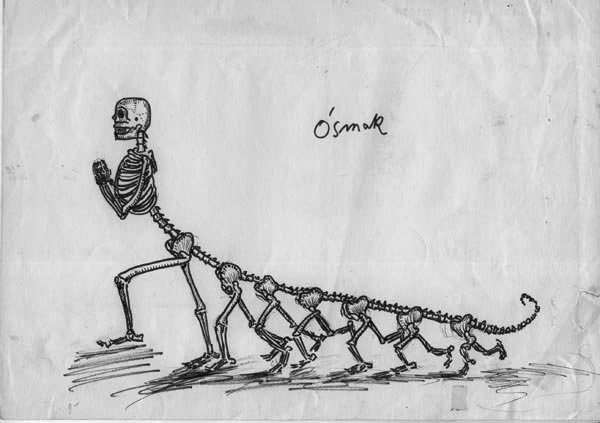
Drawing by Stanislaw Lem
 In this description I find Lem to be a kindred spirit, one who seeks to inject some important and deeper subjects into a genre which so often is looked down upon by the literary elite, possibly for good reason.

"We are all lying in the gutter, but some of us are looking at the stars."

In his essay "Phillip K Dick: A visionary amongst the Charlatans," Stanislaw Lem brings up the subject of populism.
"Knight declared himself to have been mistaken earlier in attacking books by van Vogt for their incoherence and irrationalism, on the grounds that, if van Vogt enjoys an enormous readership, he must by that very fact be on the right track as an author, and that it is wrong for criticism to discredit such writing in the name of arbitrary values, if the reading public does not want to recognize such values. The job of criticism is, rather, to discover those traits to which the work owes its popularity. Such words, from a man who struggled for years to stamp out tawdriness in SF, are more than the admission of a personal defeat—they are the diagnosis of a general condition."
Should mass appeal make the work beyond reproach? I don't think so. Great art is rarely the most popular.

Does performances of the Carnival Arts have to loose their mass appeal when meaning is introduced? Let me rephrase the question. Does important topics necessarily make shows boring? I don't think they have to, but often they are.
Usually because the issues discussed in the performance are just that; discussed, or talked about. Some current political issue is just plastered on top of a performance like cheap wallpaper or shoved in between acts like mortar between tiles. This will not work. We must be more subtle and creative than that because our Crowds are smarter than that.
MANAGER
I know how one the People’s taste may flatter,
Yet here a huge embarrassment I feel:
What they’re accustomed to, is no great matter,
But then, alas! they’ve read an awful deal.

People say: nobody likes being preached to, but there are millions of religious people out there who gets preached at constantly so people can't mind it that much. I think it is a context thing. People don't mind being preached at when they are in church because they don't expect anything better from their local priest. Whilst when it comes to entertainment, they are a lot more choosy.
Squirrel powered musicbox
If a Showman has something to say, beyond the elements of his craft ie juggling, tightwire walking, magic etc, the Showman must make it funny or moving or scary or cool and fundamentally part of the act. Meaning should not be plastered over the top of an act it needs to be woven through it. Further and most importantly it needs to come across as real. If the person delivering the meaningful material doesn't believe in it 100% it will not work. But if they do share the passion so genuinely the Crowd might accept it and enjoy it in the most crude and preachy form, but I wouldn't rely on it. So make the meaning into material, treat the meaningful stuff with as much work as you do with your tricks and your Craft.
SO, for meaningful material to work it needs to be flawlessly integrated into the tricks and skill, it needs to be well crafted to hold its own as material whilst simultaneously ring true.

Most of the time when Showmen attempts this it falls flat, which must indicate it is a difficult thing to get right, but just because it's difficult doesn't mean we should stop trying. Rather the opposite. Like JFK said about the mission to get man to the moon:
"We choose to go to the moon in this decade and do the other things, not because they are easy, but because they are hard, because that goal will serve to organize and measure the best of our energies and skills, because that challenge is one that we are willing to accept, one we are unwilling to postpone, and one which we intend to win."

Carnival Chronicles

The Logo that separates the Carnies from the Riff Raff
My fellow creator and brother in arms Hamish McCormick have begun a fine project over on vimeo which should illicit attention to the readers of the Illuminated Showman. Hamish is the brains behind the independent film production house Carnival Cinema, of which yours truly is a co-founder.
The project is called the Carnival Chronicles and appears in weekly installments. Short sharp clips that encapsulates the (mainly) Australian Showmen and Contemporary Carnival scene.

I would strongly recommend you all to check out his fine cutting and shooting craftmanship, and while you're at it follow him on vimeo. If you are not already a member, it literally takes 1min to do. It will set you up for carnival delights entering your digital device of your choosing for the future.

Here is one of my favorites; a short film called Carnival Casino I hope you enjoy it.


Selasa, 03 Juli 2012

Girls and Stars

Rockstars, Showmen,
writers and actors
all have girls.
Girls love fame,
Like we all do.

After shows girls
tries to meet their star.
And the stars love that.
It’s often why they
became stars in the
first place.

During the show
The star is in full control.
How we all long to find
Someone that knows what’s going on.

Stars give the appearance of knowing,
But trust me when I tell you that in the
remaining 23 hours of the day they are
as lost as everyone.

But the girls help them forget this.


(I wrote this poem in the year 2000.) 

Senin, 02 Juli 2012

Kafka goes to the Circus


"First Sorrow" (German: "Erstes Leid") is a short story by Franz Kafkaprobably written between the fall of 1921 and the spring of 1922. It appeared in an art periodical called Genius, III no. 2 (dated 1921, actually published in 1922)[1]and in the Christmas 1923 supplement to the "Prager Presse". The story was also included in the collection A Hunger Artist (Ein Hungerkünstler) published soon after Kafka's death.

 In this story Kafka sets his peculiar existentialistic mind into that of a trapeze artist. As with many of his stories they are at the same time very straight forward and familiar whilst simultaneously hinting at deeper uncanny meanings. This is just the kind of material we enjoy here at the Illuminated Showman. What the story means seem to be as obtuse for scholars as for the general reader. The panoply of interpretations out there seems to reveal nothing less than that the story means what you take it to mean, even if that is nothing at all.
I find it fascinating as a kind of experimental myth and as someone who take a great interest in the mythopoetics of Circus and Carnival arts I really appreciate its dualism of familiar and fantastic. 

"In fact, the theme seems so large for such a short story, i.e. the notion that expanding on one's world (however cramped it is) by any measure is a rubicon of unease."


The illustrations were made by Argentinian artist Christian Montenegro for a South American edition the story.


First Sorrow


by Franz Kafka, translated by Willa and Edwin Muir

A TRAPEZE ARTIST—this art, practiced high in the vaulted domes of the great variety theaters, is admittedly one of the most difficult humanity can achieve—had so arranged his life that, as long as he kept working in the same building, he never came down from his trapeze by night or day; at first only from a desire to perfect his skill, but later because custom was too strong for him. All his needs, very modest needs at that, were supplied by relays of attendants who watched from below and sent up and hauled down again in specially constructed containers whatever he required. This way of living caused no particular inconvenience to the theatrical people, except that, when other turns were on the stage, his being still up aloft, which could not be dissembled, proved somewhat distracting, as also the fact that, although at such times he mostly kept very still, he drew a stray glance here and there from the public. Yet the management overlooked this, because he was an extraordinary and unique artist. And of course they recognized that this mode of life was no mere prank, and that only in this way could he really keep himself in constant practice and his art at the pitch of its perfection.
       Besides, it was quite healthful up there, and when in the warmer seasons of the year the side windows all around the dome of the theater were thrown open and sun and fresh air came pouring irresistibly into the dusky vault, it was even beautiful. True, his social life was somewhat limited; only sometimes a fellow acrobat swarmed up the ladder to him, and then they both sat on the trapeze, leaning left and right against the supporting ropes and chatted, or builders’ workmen repairing the roof exchanged a few words with him through an open window, or the fireman, inspecting the emergency lighting in the top gallery, called over to him something that sounded respectful but could hardly be made out. Otherwise nothing disturbed his seclusion; occasionally, perhaps, some theater hand straying through the empty theater of an afternoon gazed thoughtfully up into the great height of the roof, almost beyond eyeshot, where the trapeze artist, unaware that he was being observed, practiced his art or rested.
       The trapeze artist could have gone on living peacefully like that, had it not been for the inevitable journeys from place to place, which he found extremely trying. Of course his manager saw to it that his sufferings were not prolonged one moment more than necessary; for town travel, racing automobiles were used, which whirled him, by night if possible or in the earliest hours of the morning, through the empty streets at breakneck speed, too slow all the same for the trapeze artist’s impatience; for railway journeys, a whole compartment was reserved, in which the trapeze artist, as a possible though wretched alternative to his usual way of living, could pass the time up on the luggage rack; in the next town on their circuit, long before he arrived, the trapeze was already slung up in the theater and all the doors leading to the stage were flung wide open, all corridors kept free—yet the manager never knew a happy moment until the trapeze artist set his foot on the rope ladder and in a twinkling, at long last, hung aloft on his trapeze.
       Despite so many journeys having been successfully arranged by the manager, each new one embarrassed him again, for the journeys, apart from everything else, got on the nerves of the artist a great deal.
       Once when they were again traveling together, the trapeze artist lying on the luggage rack dreaming, the manager leaning back in the opposite window seat reading a book, the trapeze artist addressed his companion in a low voice. The manager was immediately all attention. The trapeze artist, biting his lips, said that he must always in the future have two trapezes for his performance instead of only one, two trapezes opposite each other. The manager at once agreed. But the trapeze artist, as if to show that the manager’s consent counted for as little as his refusal, said that never again would he perform on only one trapeze, in no circumstances whatever. The very idea that it might happen at all seemed to make him shudder. The manager, watchfully feeling his way, once more emphasized his entire agreement; two trapezes were better than one, besides it would be an advantage to have a second bar, more variety could be introduced into the performance. At that the trapeze artist suddenly burst into tears. Deeply distressed, the manager sprang to his feet and asked what was the matter, then getting no answer climbed up on the seat and caressed him, cheek to cheek, so that his own face was bedabbled by the trapeze artist’s tears. Yet it took much questioning and soothing endearment until the trapeze artist sobbed: “Only the one bar in my hands—how can I go on living!” That made it somewhat easier for the manager to comfort him; he promised to wire from the very next station for a second trapeze to be installed in the first town on their circuit; reproached himself for having let the artist work so long on only one trapeze; and thanked and praised him warmly for having at last brought the mistake to his notice. And so he succeeded in reassuring the trapeze artist, little by little, and was able to go back to his corner. But he himself was far from reassured; with deep uneasiness he kept glancing secretly at the trapeze artist over the top of his book. Once such ideas began to torment him, would they ever quite leave him alone? Would they not rather increase in urgency? Would they not threaten his very existence? And indeed the manager believed he could see, during the apparently peaceful sleep which had succeeded the fit of tears, the first furrows of care engraving themselves upon the trapeze artist’s smooth, childlike forehead.

Kamis, 28 Juni 2012

Tellers Seven Secrets of Magic


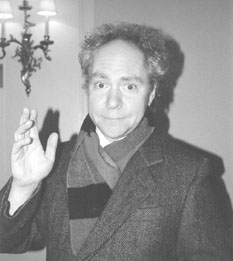
For those amongst you which dabble in the arts of prestidigitation these Secrets are important, but the core principals are worth taking note of for any Showman. The advice comes from Teller, probably most famous for being the silent part of the dynamic magic duo Penn and Teller. 

Teller
"Teller (born Raymond Joseph Teller; February 14, 1948) is an American magician, illusionist, comedian, writer, and the frequently silent half of the comedy magic duo Penn & Teller, along with Penn Jillette. Teller is an atheist, debunker, skeptic, and a fellow of the Cato Institute (a free marketlibertarianthink tankwhich also lists his partner Penn Jilletteas a fellow). The Cato Institute Association is featured prominently in the Penn and Teller Showtime TV series Bullshit!. He legally changed his name to just "Teller"."
Wikipedia

Teller shared his Secrets of Magic in a fine article from the Smithsonian Magazine. You can read the full article here.

1. Exploit pattern recognition. I magically produce four silver dollars, one at a time, with the back of my hand toward you. Then I allow you to see the palm of my hand empty before a fifth coin appears. As Homo sapiens, you grasp the pattern, and take away the impression that I produced all five coins from a hand whose palm was empty.

2. Make the secret a lot more trouble than the trick seems worth. You will be fooled by a trick if it involves more time, money and practice than you (or any other sane onlooker) would be willing to invest. My partner, Penn, and I once produced 500 live cockroaches from a top hat on the desk of talk-show host David Letterman. To prepare this took weeks. We hired an entomologist who provided slow-moving, camera-friendly cockroaches (the kind from under your stove don’t hang around for close-ups) and taught us to pick the bugs up without screaming like preadolescent girls. Then we built a secret compartment out of foam-core (one of the few materials cockroaches can’t cling to) and worked out a devious routine for sneaking the compartment into the hat. More trouble than the trick was worth? To you, probably. But not to magicians.

3. It’s hard to think critically if you’re laughing. We often follow a secret move immediately with a joke. A viewer has only so much attention to give, and if he’s laughing, his mind is too busy with the joke to backtrack rationally.

4. Keep the trickery outside the frame. I take off my jacket and toss it aside. Then I reach into your pocket and pull out a tarantula. Getting rid of the jacket was just for my comfort, right? Not exactly. As I doffed the jacket, I copped the spider.

5. To fool the mind, combine at least two tricks. Every night in Las Vegas, I make a children’s ball come to life like a trained dog. My method—the thing that fools your eye—is to puppeteer the ball with a thread too fine to be seen from the audience. But during the routine, the ball jumps through a wooden hoop several times, and that seems to rule out the possibility of a thread. The hoop is what magicians call misdirection, a second trick that “proves” the first. The hoop is genuine, but the deceptive choreography I use took 18 months to develop (see No. 2—More trouble than it’s worth).

6. Nothing fools you better than the lie you tell yourself. David P. Abbott was an Omaha magician who invented the basis of my ball trick back in 1907. He used to make a golden ball float around his parlor. After the show, Abbott would absent-mindedly leave the ball on a bookshelf while he went to the kitchen for refreshments. Guests would sneak over, heft the ball and find it was much heavier than a thread could support. So they were mystified. But the ball the audience had seen floating weighed only five ounces. The one on the bookshelf was a heavy duplicate, left out to entice the curious. When a magician lets you notice something on your own, his lie becomes impenetrable.

7. If you are given a choice, you believe you have acted freely. This is one of the darkest of all psychological secrets. I’ll explain it by incorporating it (and the other six secrets you’ve just learned) into a card trick worthy of the most annoying uncle.


Tolstoy on Art

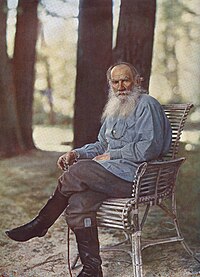
Leo Tolstoy, in his essay “What Is Art?”:

Art is not, as the metaphysicians say, the manifestation of some mysterious idea of beauty or God; it is not, as the aesthetical physiologists say, a game in which man lets off his excess of stored-up energy; it is not the expression of man’s emotions by external signs; it is not the production of pleasing objects; and, above all, it is not pleasure; but it is a means of union among men, joining them together in the same feelings, and indispensable for the life and progress toward well-being of individuals and of humanity.

Rabu, 27 Juni 2012

Ira Glass on Storytelling

Ira Glass is the producer of an American Public Radio show called This American Life. It is a weekly hour-long radio program produced by WBEZ and hosted by Ira. The show has about two million listeners a week and is essentially a story telling program. Every week he seeks out stories as diverse as psychopathy, car show culture, people who are their own worst enemies, and neighborhood watch.

In the following clips Ira Glass shares some of his ideas on the pleasures and pains of having to create stories on a regular basis. Like how when you start; be prepared for your work not matching your own standards. Remember that you are already an experienced story judge. You have read hundreds of stories and essays and for the first few years you will read your own stories and find that they fall short of your own high expectations. Your taste is better than your grasp of the craft. This is normal and everyone goes through it, or that is to say many people actually never get through this. But the great ones did. The key to overcome this is perseverance. Do work, lots of it, unpaid, or paid does not matter, you need to practice. Great advice to getting through it and at least have a shot at the Great Stories.

It is an inspirational and straight forward, practical talk. I hope you enjoy it. 

Part One:

    Part Two:

Part Three:

And Finally Part Four: 

(Thanks to Open Culture for posting this.) 

Senin, 25 Juni 2012

Philippe Petite & the Sydney Harbour Bridge

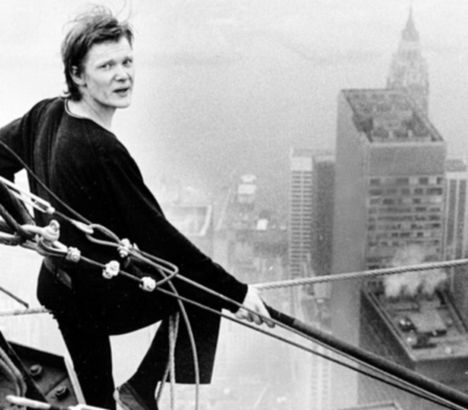
In 1974 Phillipe Petite and some of his friends performed a circus heist, as they illegally mounted a highwire between the two twin towers. The story of this is expertly told in the 2008 Oscar winning documentary Man on Wire.

This clip is an original 1974 news report about the extraordinary incident.
For disorderly conduct and criminal trespassing he was sentenced to doing a free show for children in Central park. How come we don't live in a world where this is the norm? I love the feat, the irreverent act of illegal circus and I love the justice systems response.

"Why did you do this?
there is no why, Just because when I see a beautiful place to put my wire, I can not resist."

The year before he stretched his wire between the twin towers he did a similar walk but in Sydney Australia where he stretched his wire out between the north pylons of the Sydney Harbour Bridge. I found this documentary made by the Australian film makers James and Jesse Ricketson.

Part One:

Part Two:

And finally here is the funambulist talking about himself at TED 2012.


Selasa, 19 Juni 2012

Art is the most Beautiful of All Lies

The theme of lies and deceits and the peculiar truths that can be revealed through them is a favorite here on the Illuminated Showman. When I woke at five in the morning due to jet lag and trawled the digital showground for inspiring showmen I was quite pleased to find magician Marco Tempest's performance at TED: Edinburgh in 2011. In it he uses three iPods in a sweet mix of Real Magic and digital wizardry. Something about this brings Arthur C. Clarke's third Law to mind.
"Any sufficiently advanced technology is indistinguishable from magic."
 In the following clip Marco Tempest beautifully blurs the line of magic and technology.

Claude Debussy said: "Art is the greatest deception of all." Marco Tempest adds:
"Art is a deception that creates real emotion. A lie that creates a truth, and when you give yourself over to that deception it becomes magic."


(The rest of the Debussy quote goes as follows:
Art is the greatest deception of all. And although people try to incorporate the everyday events of life in it, we must hope that it will remain a deception lest it become a utilitarian thing, sad as a factory. ... Let us not disillusion anyone by bringing too much reality into the dream.)

Rabu, 13 Juni 2012

Ken Burns on the Art of Storytelling

 The following quotes are from the clip below where film maker Ken Burns shares his thoughts on story.
In a common story one and one equals two but the real genuine stories are about one and one equaling three.That's what I'm interested in.

My interest is always in complicating things.

Jean Luc Goddard said cinema is truth 24 frames a second, maybe... But it is lying 24 frames a second too. All story is manipulation. Is there acceptable manipulation? You bet! People say: "Oh boy I was so moved - to tears in your film." That's a good thing. I manipulated that.

Truth is the byproduct of the best of our stories... An emotional truth is something that you have to build.
He tells a story in his film Baseball, a nineteen hour long film, about a team which got a black player Jackie Robinson. He asks what would you do if you were a fan of that team but also a racist? You could quit baseball, you can start following another team or you can change. This is the power of story to create change. This is why we need to always consider story in our acts. The audience will see story in our acts even when you never thought of it in that way. We see story even when there is none. Animation of geometric shapes is read as story. Story is everywhere and it is human. Consider your acts as stories and think which story are they telling?

"All stories are Manipulation," Ken Burns says. "All shows are manipulation," says the Illuminated Showman. Use the shows wisely and use it for good. Take time to consider your manipulations.

Sabtu, 09 Juni 2012

Vauduville Running Orders

A command of the art of balancing a show is a part of the genius of a great showman. It is a gift. It cannot be analyzed. A born showman lays out his bill, not by rule, but by feeling.

The following is an excerpt from Brett Page's 1915 book 'Writing Vaudeville.' It deals with the complexities of putting together a showbill or running order. Some of the advice seems a little peculiar and tells of peculiarities of the times. Like how he suggests haveing a final act that does not get too disturbed by people leaving to get to their "after-theatre supper and dance."
But perhaps it could give a few ideas to ponder for those who are struggling to put together a full show.


The excerpt is from chapter one, "the Why of the Vaudeville Act."


"We usually select a 'dumb act' for the first act on the bill. It may be a dancing act, some good animal act, or any act that makes a good impression and will not be spoiled by the late arrivals seeking their seats. Therefore it sometimes happens that we make use of a song-and-dance turn, or any other little act that does not dependon its words being heard.
"For number two position we select an interesting act of the sort recognized as a typical 'vaudeville act.' It may be almost anything at all, though it should be more entertaining than the first act. For this reason it often happens that a good man-and-woman singing act is placed here. This position on the bill is to 'settle' the audience and to prepare it for the show.
"With number three position we count on waking up the audience. The show has been properly started and from now on it must build right up to the finish. So we offer a comedy dramatic sketch--a play let that wakens the interest and holds the audience every minute with a culminative effect that comes to its laughter-climax at the 'curtain,' or any other kind of act that is not of the same order as the preceding turn, so that, having laid thefoundations, we may have the audience wondering what is to come next.
"For number four position we must have a 'corker' of an act--and a 'name.' It must be the sort of act that willrouse the audience to expect still better things, based on the fine performance of the past numbers. Maybe thisact is the first big punch of the show; anyway, it must strike home and build up the interest for the act thatfollows."
And here for number five position, a big act, and at the same time another big name, must be presented. Or it might be a big dancing act--one of those delightful novelties vaudeville likes so well. In any event this act must be as big a 'hit' as any on the bill. It is next to intermission and the audience must have something reallyworth while to talk over. And so we select one of the best acts on the bill to crown the first half of the show."
The first act after intermission, number six on the bill, is a difficult position to fill, because the act must not let down the carefully built-up tension of interest and yet it must not be stronger than the acts that are to follow. Very likely there is chosen a strong vaudeville specialty, with comedy well to the fore. Perhaps a famous comedy dumb act is selected, with the intention of getting the audience back in its seats without too many conspicuous interruptions of what is going on on the stage. Any sort of act that makes a splendid start-off is chosen, for there has been a fine first half and the second half must be built up again--of course theprocess is infinitely swifter in the second half of the show--and the audience brought once more into a delighted-expectant attitude.
"Therefore the second act after intermission--number seven--must be stronger than the first. It is usually a full-stage act and again must be another big name. Very likely it is a big play let, if another sketch has not been presented earlier on the bill. It may be a comedy play let or even a serious dramatic play let, if the star is a fine actor or actress and the name is well known. Or it may be anything at all that builds up the interest andappreciation of the audience to welcome the 'big' act that follows.
"For here in number eight position--next to closing, on a nine-act bill--the comedy hit of the show is usually placed. It is one of the acts for which theaudience has been waiting. Usually it is one of the famous 'single' man or 'single' women acts that vaudeville has made such favorites.
"And now we have come to the act that closes the show. We count on the fact that some of the audience will be going out. Many have only waited to see the chief attraction of the evening, before hurrying off to their after-theatre supper and dance. So we spring a big 'flash.' It must be an act that does not depend for its success upon being heard perfectly. Therefore a 'sight' act is chosen, an animal act maybe, to please the children, or a Japanese troupe with their gorgeous kimonos and vividly harmonizing stage draperies, or a troupe of white-clad trapeze artists flying against a background of black. Whatever the act is, it must be a showy act, for it closes the performance and sends the audience home pleased with the program to the very last minute.

"Now all the time a booking-manager is laying out his show, he has not only had these many artistic problem son his mind, but also the mechanical working of the show. For instance, he must consider the actual physical demands of his stage and not place next each other two full-stage acts. If he did, how would the stage hands change the scenery without causing a long and tedious wait? In vaudeville there must be no waits. Everything must run with unbroken stride. One act must follow another as though it were especially made for the position. And the entire show must be dovetailed to the split seconds of a stop-watch.
"Therefore it is customary to follow an 'act in One' (See below) with an act requiring Full Stage. Then after the curtain has fallen on this act, an act comes on to play in One again. A show can, of course, start with a full-stage act, and the alternation process remains the same. Or there may be an act that can open in One and then go into Full Stage--after having given the stage hands time to set their scenery--or vice versa, close in One. Briefly, the whole problem is simply this--acts must be arranged not only in the order of their interest value, but also according to their physical demands.

"But there is still another problem the manager must solve. 'Variety' is vaudeville's paternal name—vaudeville must present a varied bill and a show consisting of names that will tend to have a box-office appeal. No two acts in a show should be alike. No two can be permitted to conflict. 'Conflict' is a word that falls with ominous meaning on a vaudeville performer's or manager's ears, because it means death to one of the acts and injury to the show as a whole. If two famous singing 'single' women were placed on the same bill, very likely there would be odious comparisons--even though they did not use songs that were alike. And however interesting each might be, both would lose in interest. And yet, sometimes we do just this thing--violating a minor rule towin a great big box-office appeal.
"Part of the many sides of this delicate problem may be seen when you consider that no two 'single' singing acts should be placed next each other--although they may not conflict if they are placed far apart on the bill. And no two 'quiet' acts may be placed together. The tempo of the show must be maintained--and because tragic playlets, and even serious playlets, are suspected of 'slowing up a show,' they are not booked unlessvery exceptional.
"These are but a few of the many sides of the problem of what is called "laying out a show." A command of the art of balancing a show is a part of the genius of a great showman. It is a gift. It cannot be analyzed. A born showman lays out his bill, not by rule, but by feeling.
I discovered this book through John Towsen's scribed account.
 

Kamis, 07 Juni 2012

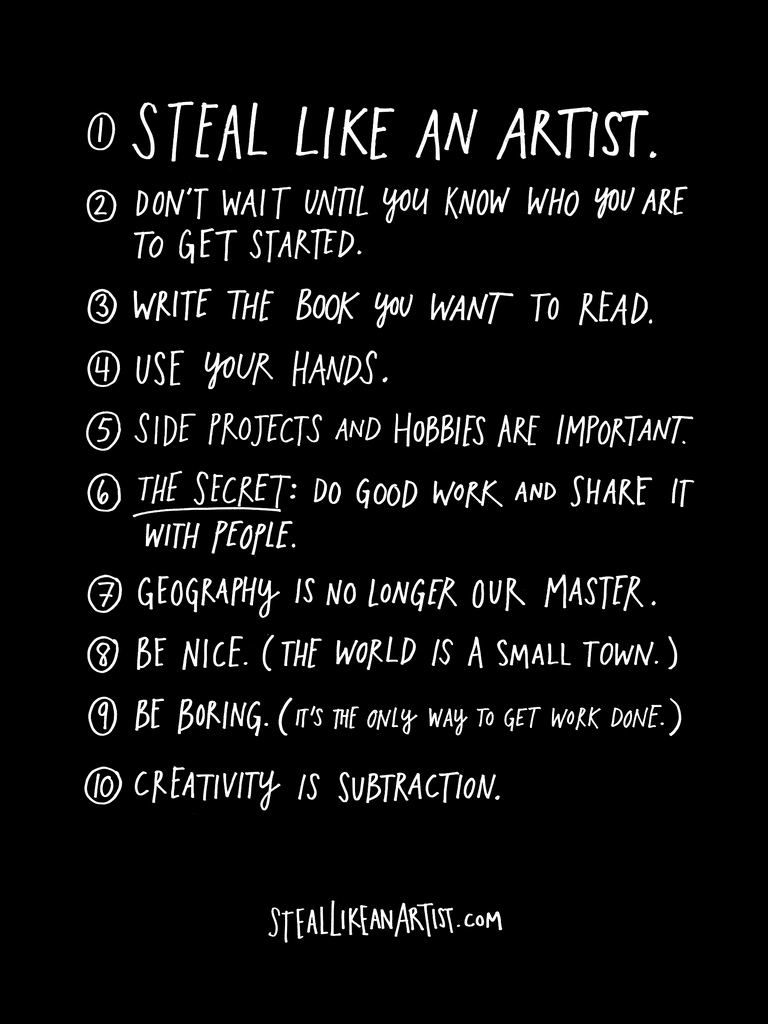
Steal like an Artist

So thoughts about originality and 'borrowing' material to get started as a showman has been milling around my brain.
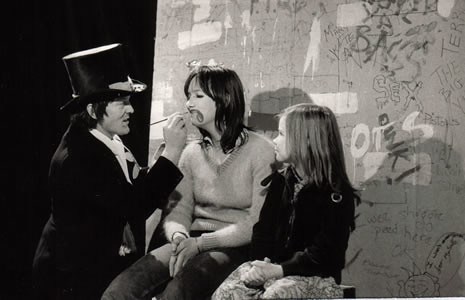
Santini's Magi Show circa 1990.
My first acts as an assistant in my dad's magic show were all so called packet tricks. Torn and restored paper, some rope tricks, milk pitcher etc, standard tricks you can buy in any magic shop. With magic the game is a little different than with circus acts. Many professional magicians makes a good living from selling their original ideas and the workings of effects, often complete with suggested patter and presentation.
As we all know its not enough to do a magic trick, or juggle three balls, or balance an ax on your chin, to make a crowd like you and bookings fill your calender. There is more to it than that. Many people say it and I heard it first from my dad, the Great Santini:

"It is not what you do, but how you do it that matters."

Ultimately people don't care about whether you can juggle the three machetes, or make the little red silk disappear, but if they like you and you care about it, then you can make them care too. So it's not enough to have an act, you need to work on the presentation. Make it ring true for an audience. Whether you learnt it from a magic book or you "created it all," it must be real so that when you present it it becomes genuine. If you manage that your act will become Truth for the crowd, and Crowds love Truth.
To do so you have to do more than just present a series of tricks. You need to have thought about what it is you want to achieve. Consider what you want the Crowd to be left with after they have seen it.
Of course if juggling or magic is only going to be your hobby or you are only interested in it for the sake of the art, then all bets are off, you can then spend as much time as you want going in any direction you want. But if you do want to use these skills to connect with a crowd you need to think of how to make your acts go beyond mere presentation of skill and become engaging for an audience.
This is a very difficult task, particularly if you're just starting out, therefor it is OK even recommended, or at least accepted, for Novice Showmen to mine material from the collective pool of stock tricks and acts. But it is important to remember that unless you graduate from the tried and tested routines and put your own personal stamp on them, transform them so that YOU become the main part of the act, not your tricks, you will have trouble getting recognition as an artist and often you'll also have trouble getting other work than tiny shows at provincial shopping malls. Not to say there is not great art and good times to be had at such places.
Aksdal Shopping centre.
I cut my teeth at places like Aksdal Senter. A shopping mall in a tiny village not too far from where I grew up, not so much a village as a cluster of houses next to the intersection of highway that goes to Stavanger and Oslo. Doing those shows strengthened the Funny Bones I now stand on. But I wanted more than that. I took the lessons and moved on. I found my own style, it took a long time, but I found it. And if I can find it, anyone can.
As the song says: "If you can make it here, you can make it anywhere."

(Although said about a slightly bigger city than Aksdal...)

Inspiring words from Austin Kleon. Worth checking out!

Here is a key excerpt from the gloriously enlightening movie Funny Bones about this particular issue of borrowing to get a head start and the terrible fact of life that many of our fellow performers never goes beyond this initial Novice Showman stage. They never find a Master, a mentor that can take them under their wing and show them the ropes, to make them Apprentice Showmen. On our own we stumble blindly in the dark. Learning and to some extent stealing from our idols can make us who we are. But the important thing is to steal like an artist: copy, combine and transform. Don't rip off.

The following is a conversation between Oliver Platt as Tommy Fawkes as he learns that his dad, Mr Originality himself stole material. The father is played by Jerry Lewis.

 
Mr Originality stole material?
"Why did you steal their whole act?

Because you loved them so much?"

"No, because I wanted a new act

that no one had seen in the States.

I was ambitious. Is that a crime?

Did you never steal material, son?

I knew their act.

It was a way in for me. Just a way in.

I did it a couple of years,

then I became a joke man.

Let me tell you something straight.
Tommy Fawkes in his fathers footsteps.
 
About what kills me.                  

It kills me that I got lazy,

using writers, not using me.

We were funny! We didn't have to tell

funny stories. We were funny.

We had funny bones!

And what kills me most is watching

my own son flop time after time.

However much I spent on writers and

coaches, it hasn't worked for you.

It's like you're too educated

to be funny.

All this analysis. I did that!

There are two types of comedians.

A funny bones comedian,

and a non-funny bones comedian.

They're both funny.

One is funny, the other tells funny.

And Tommy...
 
It's time you knew...and this

kills me the most,

You're not funny."

Senin, 04 Juni 2012

Circus to Save the World

Reg Bolton was an Australian doctor of social circus. His PhD Why circus work is an important addition to understanding how uniquely suited our Craft is suited to help young people develop into healthy human beings.
The following article is a keynote speech he held in Sarasota, Florida, USA for the American Youth Circus Organization in 2001.
You can find this and more of Reg's articles and thoughts here


Circus to save the world


Some people think that Circus in a Suitcase was my first book, but when I was an undergraduate student, I wrote a much more significant book. It was called 'Several Ways to Save the World', but unfortunately I lost it, and that's probably the root cause of all the trouble we're in now. So we'll have to start again from scratch.

Mike Moloney, who is an Australian who pioneered Circus work in Belfast, told me a wonderful story. There's a Women's Jail in Belfast, as well as the Men's. You are aware of the troubles in Belfast, with all the shootings and revenge shootings. Lots of men in jail, but few women. I think only about twenty and Mike Moloney was in there doing Theatre. He wanted to do some Circus as well, and he actually rigged a trapeze in the central courtyard of the Women's Jail. They were all invited to have a go at it. One or two of them had a go, and one stayed with it. A nineteen-year-old girl, and she started learning all the moves, and she started swinging. One by one, the other women gave up their alternative rest breaks to come and watch this one girl just swinging on the trapeze, just getting further each day, more fluid and more bird like. And he said the effect on that jail, on these incarcerated women was just miraculous; their spirits just soared every time this one girl sailed through the air.

We all know this magic can happen, and that's just one example. And yet, every one of us has experienced people saying, "Oh well, it's only Circus!" It's unbelievable. They say "You're just clowning around". I've had this all my life, and people say it's so shallow, so tawdry. Well, I've got a theory about that as well. In brief, it's about the Surface of Circus. Think about the Circus and the surfaces. You take an ordinary field. One day it's grass next day it's sawdust, and then it's grass again, it's gone. Our 'cathedral' here is skin-deep, then it's the real world outside. What do you see of the performers? You see the surface, you see the leotard, the sequins, the clown's face-paint, and that's all. Then, when it's gone, all you see is the poster, peeling off the wall, it's just the surface.
Do we want them to see beyond the surface? Or are we quite happy to let them think what they want to think? I say that because I'm fed up with saying, "There's a lot more to it than you think. This is really deep." They say "Oh Yeah," and yawn. They don't want to know. We don't have to tell them. We just have to make the surface pretty brilliant, and just leave it at that.
Now, one of your famous philosophers, and writers, Ernest Hemingway said, "The Circus is the only spectacle I know of, that when you are watching it, has the quality of a truly happy dream". I often thought it's a bit mundane, a bit banal, it's not like 'May all Your Days be Circus Days' and 'The Greatest Show on Earth'. "Has the quality of a truly happy dream…" The more I thought about it the more I realized he's got it absolutely spot on. Because think of the unhappy dreams. Think of nightmares. Think of the symbols that you get in dreams. As Jung's theory of the collective unconscious suggests, we all seem to have the same sort of dreams. When we were sitting out here last night, watching the Circus, we saw some of the things on this list of absolute nightmare phobias.
Fear of falling. We saw them up there, but they didn't fall.
Fear of exposure (being out in the middle with everybody looking at you). It's what we do.
Fear of meeting wild animals. People do that on our behalf. They don't get eaten. Well, apart from my friend Geoffrey Lennon, who's now officially a half-assed lion trainer. The lion's bit his bum a week ago Saturday. Geoffrey Lennon, I dedicate this short talk to you.
Fear of unstable ground. Have you ever been in an earthquake, or felt tremors? It's weird. Yet here are people standing on rolling globes, and teeter boards.

Look up your Jung and your Freud, and you'll find all the symbols in dreams - ropes, knives, ladders, fire ….. They recur in dreams all the time. Yet these are the things we live with. It's what we do.
And finally, let's look at clowns and how close clowns are to our dreams. Dreams of humiliation. Dreams of being with a big boss, with whom you have no power, dreams of being chased. Dreams of wearing the wrong clothes. How was it when we were seven years old, and we were wearing the untrendy gear? How deeply humiliating that was. Clowns always wear the wrong clothes. Dreams of making a social mistake, like using the wrong knife and fork, yet clowns do it compulsively. They have this total and irrevocable inability to get things right.
Circus takes us into our worst dreams, yet act after act gives us a happy ending.
Circus as a Metaphor. You know how they say "We don't need a circus in this school, it's a Circus already, Ho, ho, ho." Don't you hate that? "'This company is a Circus. We've got a lot of clowns around here". I've looked this up. It seems it is an American who first used this expression "This company runs like a three ring circus" This is meant to be derogatory! If only!
If only a company could run like a Circus. If only the boss could one day announce the most astonishing and unlikely policy or agenda like "Now we are going to….." and then he steps aside… and then they do it.! If only …..
If only a company had a multi-cultural policy that they really believed in, and if they didn't have people of other nations, they'd invent them! We invent them. If we haven't got foreigners…. What was the name of the Flying Act here last night? 'The Flying Gabianos'. Sounds multi-cultural to me. So if we haven't got them, we invent them.
If only, if only this company could lift its entire staff, its building, and all its operations over night, and go to another place and perform for a whole new clientele, that's what we do. They call themselves a Circus. They've got no business. If only, in a company, every single employee did the thing they were good at, and did it well - did it so well that you could truly believe that no human being has ever done it that well before. Imagine that in a company. That's what we do in the Circus. And imagine that with every single product that they put out, the public stands up and claps. And they've got the cheek to call themselves a Circus.
My theme is Circus to Save the World. Easy enough. Well, it can be. Circus is essentially generous, it's giving, it's caring and it's co-operative. What do we see in the world of cut-throat business out there? Competition, aggression, predation, annihilation.
Consumption, there's a funny thing. We hardly consume anything. We put up our tent, we do our business and we go away. When I think of consumption, I think of the golf courses that eat Hawaii, I think of office buildings dominating our cities, I think of jet-skis, I think of off-road vehicles. When I think of consumption, and of things that consume, I think of cancer, fire and locusts. They are the only things that used to consume when I was a boy, and now we're all urged to be consumers. Buy thankfully WE are not, we're essentially givers rather than takers.
Now, as you know I'm always interviewing people, and the question I most often ask is 'Why is Circus Good for Young People?' Another famous American philosopher, Whitney Houston, has summed it up "I believe that children are out future". Well, children are in trouble now. You don't know you are. I'm an old bloke, and maybe old blokes have always said this about children; but I think there's more of a threat to children now than there ever has been. Children are the most resilient, adaptable and wonderful people but, there is a pincer movement, there is a conspiracy against the culture of children. There is a cultural genocide going on. You know how we are always looking back, saying, "How could we let that happen? Slavery, women not having the vote, wiping out indigenous peoples. How could we have let that happen?" At the time it seemed the right thing to do. What are we going to see when we look back here? We're going to look at consumption, and we're going to look at the genocide of childhood. And who are the perpetrators? I'll tell you who they are - the Media , they are being used but they're also doing it, TV companies, film companies. Shoe manufacturers! Insurance companies. They take down playgrounds. They don't let you actually have any fun. You've got computers, sport OWNERS, and that's before you even bring in the pornography and the drug cartels that see children as a very nice market or product.
OK Here's the answer. I'm in the home straight now.
My view of what childhood should be (and I was lucky, I had a great one).
These are the four things that every child needs to do, and people are stopping them from doing it.
Take Risks.
Jessica (Hentoff) has a lovely thing she wrote in her publicity.
Something like -
"You fall down in order to learn how to stay on your feet". You cannot actually learn anything without taking risks. It's up to us to make sure they're not really taking risks. But the kids, once a day, have got to have their hearts in their mouths. There's a fellow in New Zealand, called Peter Birlie, who talks about the 'vertigo moment'. If you don't get that vertigo moment… Watch kids at the funfair. They go straight for the scariest, upside down, up and down things. Kids actually need a vertigo moment. Little babies need to be thrown in the air and held upside down, and swung around. Everybody needs it. We've stopped it. It's stopped happening. They don't even do it at school. They take down the swings. They don't jump from trees. They're mollycoddled in this cotton-wool existence. This is the insurance companies part in the conspiracy; and what happens? All these vertigo moments that you didn't have, you still need. So you hit adolescence; the hormones kick in, and you make up for lost time. You go for every risk you can. And that's why so many people are stealing cars, shooting up drugs and everything else. I think it's a direct cause and effect.

What do we do in the Circus? We give them risks. We swing them upside down, we chuck them around. Or they chuck themselves around. We give them risk.
The second thing every child needs. They need to show off. Every child needs to show off. "Hey Mum, look at me! Hey Dad, I can do this!" They need to do that. Sure they still do it, but there's more and more conformity. They don't show off.
I'm talking about showing off the best you can possibly be, in a controlled and safe environment, so people go "Yay! You are the goods!" Children need that, and what else do we do in Circus but that? You never say at the end of a Circus "You lost, the other team won." No. You won. You won every show. You won nearly every training. So that's another thing we're doing in Circus.

The third one, that every child needs; Trusting and touching. They both mean the same thing to me. I don't say "Fight for the right to touch", but perhaps I should; the right to touch and be touched. , Look at baby animals, every mammal spends time rolling over each other, and adult animals, cattle, sheep etc, they love to brush against each other as they're moving along. We don't. We separate things. We put children in shoes as soon as possible. They don't touch they earth, they don't touch each other, they don't touch us, we're not allowed to touch them. It is so phoney. So what do we do in Circus? "You hold that, you hold there," we bend down, we lift them up, we push them, we twist them. They jump up on us. The number of Children's Circuses I've seen where I'll be busy talking to the trainers, and suddenly, Wham! the trainers are suddenly covered in children, who use them as climbing frames. To me that is so wholesome, and so natural, and you don't often see that with the 'coach' in the basketball team, you know, they come in and give him a big cuddle. Maybe they should. But what you performers did last night, which is so beautiful to watch, is the way that you're holding each other, and lifting each other and depending on each other. You're learning a much more trustful way to look at the world.
So we've had the risking, the showing off, the trusting.
Here's the last thing all children have to do. They have to Dream. They have to have their dreams and to aspire. And they do. But what do they aspire to now? A Nintendo game machine, getting to the next level. Or the shoes, or the basket ball cards. All these things that children often are obsessed about, and hassling their parents about, and causing domestic strife about, are getting dumped on them by advertisers. They still do, deep down, dream to climb up to there, walk across there, or swing round there. Most people in the world will say, "Don't do that. Don't do that, I'll buy you a packet of basket-ball cards if you don't do that! Here we're doing the exact opposite. We're saying, "Yes, do it, please do it!" That's the fourth thing. We're actually allowing people to dream, and we're making their dreams come true.
OK, finally, the story about my plumber. You see, where I live in Perth, I've got this house, with a garden, and a swimming pool which is now a pond where we've got frogs. Here's the shed where I keep all my gear. I needed a tap for the hosepipe in the garden. So I called this plumber, and he came in with his bag of tools, and I said I want it down there, on the outside wall. Anyway, he looked up, and there are all the unicycles hanging up, in the shed, and he said "Wow! Are you in show-business." I said "Yes, sort of, but is there enough water pressure to reach down here and get this tap going?" He said "Oh gee, I always wanted to be in show-business" "Yes", I said, "and I want a really strong tap, because I've got bad garden habits, and I tend to yank that hose, and I don't want it coming off." He said "I'm so jealous. I wish I could be in Show-business". I felt like saying "Get outa here and send me someone who really wants to be a plumber!"
I didn't book him again, but the next plumber I got was fantastic. He loved plumbing. He's got me down on my hand and knees, looking in that dirty little cupboard under the sink, enthusing about the new flange he has put on the u-bend. "Oh yes," I'd say, totally inspired, "What a u-bend, what a flange!"
That man's my plumber! He has accidentally or deliberately slipped into what I accidentally or deliberately slipped in to, that is 'The Designer Life'. I think most of you have the recipe already, (I know Dave Finnigan's got it),
"You know what you like, you know what you're good at, and that's all you do.." The phone never stops ringing. Everybody wants you. Because you're the one who likes what you do, you know what you like, and you're good at it.

So if you like it, and you're no good at it - don't touch it.
If you're good at it, but you don't like it - don't touch it.
Just think yourself blessed that you're not like most people out there, who don't like it, and they're no good at it. Yet that's what they do. It's so sad.
So you're the blessed ones. You're the angels. They say that poets are "the unacknowledged legislators of mankind"- but now there's us. We've got the opportunities, and we've got the responsibilities. Yes, we can save the world. We can save the world by living the designer life, and by spreading the idea.
Some people say the Circus is the "Other", the mysterious, the weird stuff. That's what most people say about the Circus. Well, let them, they're jealous of everything they do. We won't tease them, we'll entertain them, and we'll make them feel better. Don't be intimidated by anything they say. They are so jealous of us.
We are astonishingly, incredibly lucky.